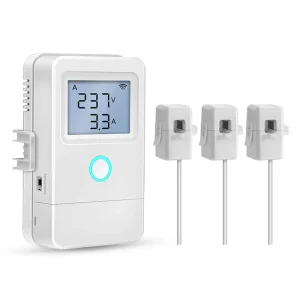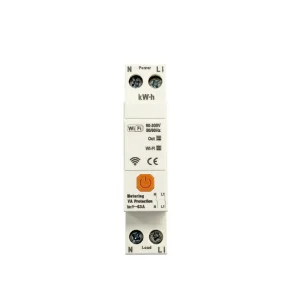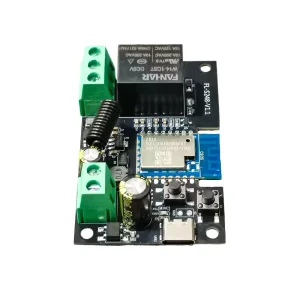
Featured Smart Power Automation & Sensing Deployments
Standardized 35mm DIN-rail modules and distributed sub-metering hardware manufactured under Class 100 cleanroom environments in Bao'an, Shenzhen.
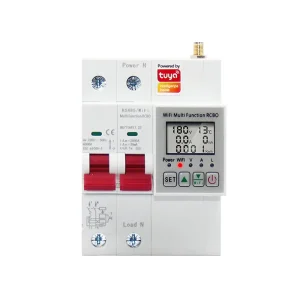
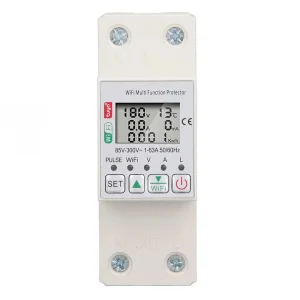
Evolution of Tuya 2P 63A Smart WiFi Circuit Breakers
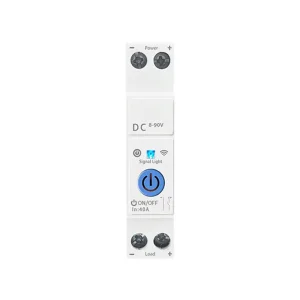
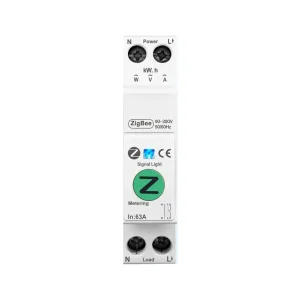
The global electrical protection market has transitioned from passive electromechanical protection (bimetallic trip strips and magnetic coils) to active, cloud-synchronized micro-grid nodes. A custom Tuya 2P 63A Smart WiFi Circuit Breaker functions as a critical bridge between legacy low-voltage distribution boards and intelligent Building Management Systems (BMS).
Synchronous Dual-Pole Interruption
Unlike standard 1P+N devices that switch only the live conductor, custom 2P 63A configurations employ a linked physical mechanism to sever both Live (L) and Neutral (N) simultaneously. This prevents phase-reversal back-feed hazards and floating neutral voltage potentials during routine circuit maintenance or inverter ground-fault events.
High-Resolution Bi-Directional Metering
Integrated energy monitoring ICs measure true RMS voltage, dynamic current draw, active power (kW), and reactive power factor. With residential Photovoltaic (PV) installations surging globally, high-tier OEM configurations deliver bi-directional energy computation to monitor clean generation vs. grid consumption.
Intelligent Dynamic Thresholding
Factory-calibrated over-voltage (250V-300V), under-voltage (145V-210V), and over-current trip limits provide millisecond response times. Automated recovery delay cycles protect inductive compressor loads (HVAC systems, heat pumps) from cycling rapidly under grid volatility.
Enterprise Procurement Requirements & Macro Industry Implementations
B2B procurement directors, electrical wholesalers, and engineering contractors operate under distinct regional specifications. Below is an architectural overview of how OEM Tuya 2P 63A hardware resolves systemic macro challenges.
Sub-Metering & Tenant Billing
Multi-family residential operators and co-living facilities integrate Tuya 2P 63A breakers as revenue-grade sub-meters. Built-in prepaid balance logic automates circuit shut-off upon credit exhaustion, managed through automated REST API webhooks connecting directly to management ERPs.
EV Charger (EVSE) Safe Circuitry
Level 2 AC wallboxes run near their continuous thermal envelope for hours. A 63A-rated breaker provides thermal headroom over standard 32A/40A draw profiles, paired with scheduled nocturnal charging routines that synchronize to low-cost dynamic utility tariffs.
Hospitality & Commercial HVAC
Boutique hotels eliminate phantom loads by tying circuit states to room occupancy sensors. 2P 63A breakers protect and switch primary feed panels to distributed ductless heat pumps and central water heating arrays without manual maintenance interventions.
Localization Support, Testing Protocols & Compliance Roadmap
Deploying high-voltage switching devices across cross-border markets mandates rigorous adherence to low-voltage directives, EMC guidelines, and telecommunication protocols. Corunsmart manufactures within an ISO 9001:2015 and BSCI-audited facility to secure full export documentation.
| Market Standard | Primary Harmonized Standards | Target Regulatory Body | Engineering Mandate |
|---|---|---|---|
| European Union (EU) | EN 60898-1, EN 62479, RED 2014/53/EU | CE / RoHS Declaration | 6kA short-circuit breaking capacity, non-combustible PA66 V-0 housing. |
| United Kingdom (UK) | BS EN 60898-1, UKCA Radio Equipment Regs | UKCA Certification | Simultaneous mechanical neutral disconnection and CE cross-verification. |
| North America (US/CA) | UL 489, UL 1053, FCC Part 15 Class B | ETL Listed / UL Listed | Enhanced dielectric creepage spacing and RF emission suppression. |
| Latin America & Global | IEC 60947-2, NOM (Mexico), INMETRO (Brazil) | National Safety Marks | High-humidity tropical testing, wide voltage fluctuation withstand (85V-275V). |
Flame-Retardant Thermo-Plastics
Enclosures are molded using virgin, glass-fiber reinforced Polyketone/PA66 compliant with UL 94 V-0 flame-resistance metrics. Glow-wire flammability index (GWFI) verified at 960°C to eliminate combustion risks during extreme overload arc-quenching events.
Physical Arc Quenching Chutes
Engineered with 9-to-12 plate splitter arc-extinction chambers. When breaking currents up to 6000A (6kA), high-speed magnetic air blowout directs plasma arcs away from sensitive wireless logic modules and Tuya connectivity chipsets.
Factory Traceability & 100% Burn-In
Every PCBA batch undergoes automated optical inspection (AOI), high-voltage hipot insulation testing (2500V AC), contact resistance calibration, and a continuous 72-hour full-load thermal burn-in prior to batch serialization and barcode packaging.
Technology Roadmap: Solid-State Switching, Matter & Open Ecosystems
While current smart circuit breakers balance mechanical relays with microcontrollers, the next 24 to 36 months will redefine the distributed power sector across three key technology axes.
Matter-over-Thread Migration
Transitioning beyond single 2.4GHz Wi-Fi topologies, future OEM architectures integrate dual-mode silicon (ESP32-C2 / ESP32-C6) enabling native Matter compliance over Thread. This decouples local switching response from cloud latency while maintaining unified management across Apple Home, Google Assistant, Amazon Alexa, and Samsung SmartThings simultaneously.
Edge AI Micro-Arc Detection
Next-gen firmware layers incorporate embedded edge inferencing models to execute real-time FFT (Fast Fourier Transform) current waveform analysis. Breakers will actively identify signature high-frequency parasitic micro-arcing (AFDD functionality) caused by damaged internal wiring before insulation ignites.
Hybrid Solid-State (SSCB) Topologies
By combining Gallium Nitride (GaN) or Silicon Carbide (SiC) semiconductor switches with traditional air-gap mechanical contactors, the industry moves toward sub-microsecond zero-arc trip speeds, delivering virtually infinite operational lifecycles without mechanical wear.
Frequently Asked Technical & Sourcing Questions
In-depth answers addressing structural reliability, network latency, OEM customization options, and installation parameters for Tuya 2P 63A circuit breakers.
What is the structural difference between a 1P+N smart breaker and a true 2P 63A smart breaker?
A 1P+N device contains an active switching mechanism and overcurrent trip unit exclusively on the Live conductor; the Neutral conductor is merely passed through or switched via an unrated auxiliary contact. A true 2P smart circuit breaker integrates dual arc chambers and symmetrical overcurrent/short-circuit detection across both poles, mechanically disconnecting both Live and Neutral simultaneously. This configuration is mandatory in regions where neutral phase lines can float or where inverter back-feed safety is paramount.
Can these custom breakers operate without an active internet connection?
Yes. Thermal-magnetic protection functions are purely physical and completely independent of cloud connectivity, microcontrollers, or Wi-Fi state. Furthermore, onboard non-volatile memory retains operational schedules, timers, and threshold configurations. If the local internet drops out, previously scheduled timers continue executing, and physical toggles maintain manual override authority at all times.
What firmware stacks can Corunsmart flash for B2B wholesale orders?
We supply base units running native Tuya IoT firmware for out-of-the-box Smart Life and OEM Tuya white-label apps. For enterprise clients requiring local, closed-loop installations, we flash custom firmware onto ESP32, ESP32-C2, and ESP32-C3 chipsets, supporting Tasmota, ESPHome, or direct MQTT integration with platforms such as Home Assistant without cloud dependencies.
How does the breaker prevent inductive kickback when turning off large inductive loads?
The power switching unit features embedded TVS (Transient Voltage Suppressor) diodes and metal oxide varistors (MOV) coupled across the switching contacts to clamp back-EMF spikes. In addition, internal control logic can be calibrated for zero-crossing switching, closing contacts precisely at the voltage zero point to eliminate inrush current spikes and arcing.
What is the standard Minimum Order Quantity (MOQ) and customization lead time?
Standard production runs for laser-etched OEM branding and localized packaging start at 500 to 1,000 units per SKU. Turnaround for custom tooling, firmware modification, and regulatory sample delivery averages 4 to 6 weeks, while mass-scale production runs from our Bao'an facility ship within 20 to 30 days.
Peripheral IoT Sensing, Isolation & Sub-Distribution Hardware
Comprehensive accessory components engineered for whole-home automation arrays, sub-station metering, and commercial panel modernization.