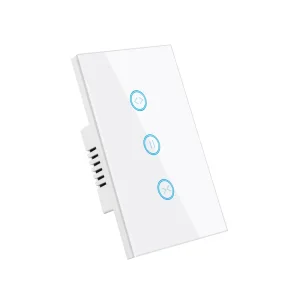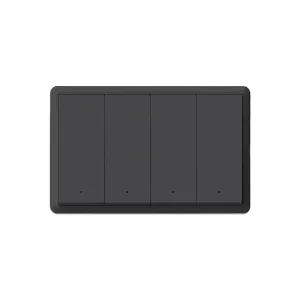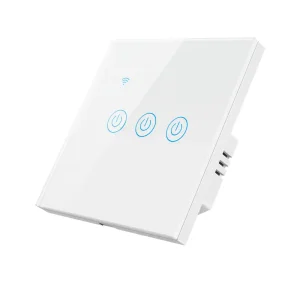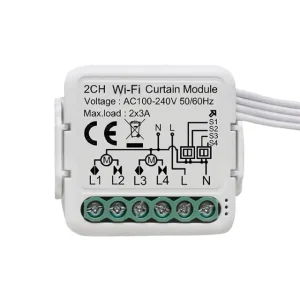
Featured High-Efficiency Smart Switches & Metering Breakers
Engineered with Class 1.0 energy calculation chipsets, active overload tripping, and cloud-agnostic firmware.
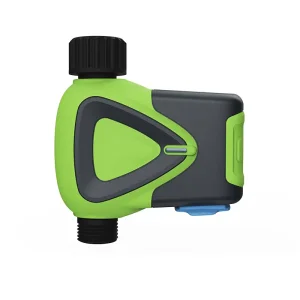
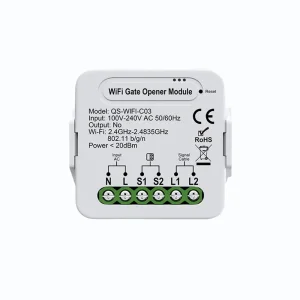
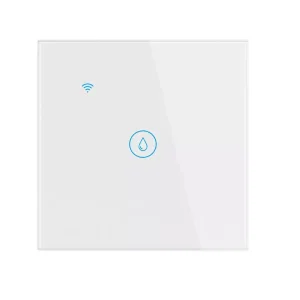
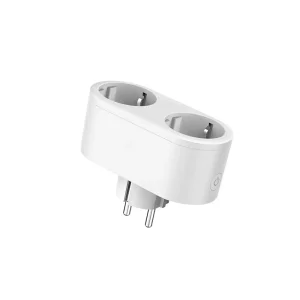
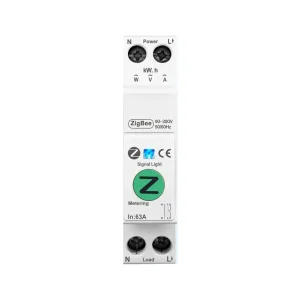
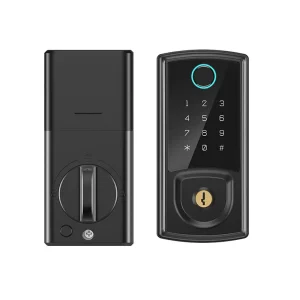
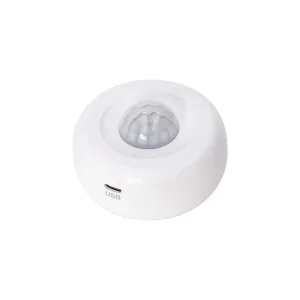
The Commercial & Industrial Landscape of Wi-Fi Smart Switch Energy Meters
Driven by net-zero regulatory frameworks, explosive renewable prosumer installations, and escalating electricity tariffs, the intersection of smart load switching and sub-cycle energy metering has transformed into a critical digital asset for global building automation and energy management systems (BEMS).
From Primitive Relays to Precision Edge Energy Telemetry
Legacy residential and light-commercial electrical installations relied heavily on crude bi-metal circuit breakers and mechanical relays. In that paradigm, switching and monitoring were entirely decoupled: switching was purely defensive (reacting to thermal overload or short-circuit events), while metering was an isolated, utility-facing monthly ledger located at the building ingress.
The proliferation of high-draw decentralized loads—specifically Residential Electric Vehicle Supply Equipment (EVSE), ductless multi-split HVAC heat pumps, micro-inverter photovoltaic arrays (Balkonkraftwerk), and dynamic battery energy storage systems (BESS)—has made macroscopic utility metering obsolete for modern optimization. Today’s industrial, commercial, and multi-tenant ecosystems require granular, sub-metered appliance-level intelligence.
China's manufacturing powerhouse has responded to this shift by fusing digital isolated metrology chipsets directly with micro-relay mechanical architectures and robust 2.4 GHz IEEE 802.11b/g/n and Wi-Fi 6 (802.11ax) microcontrollers. As a result, a modern China-manufactured Wi-Fi smart switch energy meter is not merely a remote breaker; it is an intelligent edge computational node capable of high-frequency sampling (1 kHz to 4 kHz), continuous True RMS voltage/current calculations, real-time power factor determination, and bidirectional energy accumulation.
Why Shenzhen & China Supply Chains Dominate Smart Metering Hardware
The commercial triumph of China’s smart metering and connected breaker industry is rooted in a deeply concentrated, vertically integrated electromechanical ecosystem centered in the Pearl River Delta (Shenzhen, Dongguan, Huizhou) and the Zhejiang low-voltage cluster (Wenzhou, Yueqing).
Sub-Component Localization
Within a 50-kilometer radius in Guangdong, tier-1 factories procure specialized current transformers (Manganin shunt resistors or high-permeability permalloy CTs), latching relays (silver tin oxide AgSnO2 contacts), arc chute chambers, and specialized metrology ASICs (such as Belling, Vango, or Cirrus Logic equivalents). This hyper-localized supply network compresses prototyping and engineering design iterations from months to days.
Automated Calibration Rigs
Metering precision requires zero-cross calibration. Leading Chinese factories deploy proprietary robotic calibration benches capable of simultaneously loading 128 to 256 units under variable inductive, capacitive, and resistive loads (0.1 Ib to Imax, cosφ = 0.5 to 1.0). Automated laser trimming or EEPROM calibration constant registers eliminate human assembly variance, ensuring Class 1.0 (IEC 62053) compliance at mass-market scale.
Firmware Agility & Edge Stacks
Unlike traditional Western electrical conglomerates locked into closed, proprietary fieldbus networks, Chinese OEM factories maintain extensive embedded software teams fluent in Tuya IoT OS, Espressif ESP-IDF, Matter-over-Wi-Fi, Tasmota, and custom MQTT architectures. This enables global brands to deploy unified hardware across retail channels and open-source industrial automation projects alike.
Technical Anatomy: Metrology, Isolation & RF System Architecture
To understand the longevity, thermal footprint, and accuracy of a Wi-Fi smart switch energy meter, procurement engineers must evaluate the internal schematic layers: the current transducer, the power conversion stage, and the RF isolation topology.
| Subsystem | Standard Low-Cost Topology | Industrial Tier-1 OEM Standard (Recommended) | Impact on Field Reliability & Data Integrity |
|---|---|---|---|
| Current Sensing Transducer | Low-grade resistive shunt or single-turn wire loop prone to thermal drift. | Electron-beam welded Manganin shunt (50–100 μΩ) or high-linearity Toroidal Current Transformer (CT). | Maintains <1.0% metrological linearity across full temperature envelope (-25°C to +70°C); avoids runaway heating at sustained 63A continuous loads. |
| Relay Mechanism | Standard monostable electromagnetic relay; continuously draws 1–2W in active closed state. | Magnetic latching relay (bistable) with dual AgSnO2 (Silver Tin Oxide) contacts. | Zero holding power consumption, preventing heat accumulation inside dense DIN-rail enclosures; immune to load contact welding under high inrush currents (LED capacitive loads). |
| Metrology Dedicated IC | Software-based ADC sampling executed on the main Wi-Fi SOC core. | Independent Hardware Metrology Chip (BL0942, HLW8032, RN8209C) with dedicated high-speed Sigma-Delta ADCs. | Offloads intensive mathematical DSP calculations (RMS, instantaneous active/reactive power); prevents telemetry dropped packets when Wi-Fi re-authenticates. |
| Surge & Overvoltage Protection | Minimal metal oxide varistor (MOV 7D) lacking thermal fuse protection. | Multi-stage protection: High-joule MOV (14D/20D) paired with transient voltage suppression (TVS) diodes and thermal cutoffs. | Passes 4kV–6kV lightning impulse tests (IEC 61000-4-5) without catastrophic housing ignition or dielectric breakdown. |
| Creepage & Clearance | Minimal PCB routing isolation (<2.5 mm). | Physical optocoupler isolation / magnetic digital isolators; PCB slot milling with >6.3 mm creepage between high-voltage bus and low-voltage MCU. | Ensures full compliance with IEC/UL 61010-1 electrical safety and SELV (Safety Extra-Low Voltage) insulation benchmarks. |
Radio-Frequency Performance & Antenna Design in Metal Enclosures
A chronic engineering vulnerability in connected switchboard equipment is RF attenuation caused by grounded metal consumer units (distribution boxes). Leading Chinese factories overcome this via dual-path antenna strategies: internal high-gain PCB inverted-F antennas (PIFA) coupled with micro-coaxial IPEX/U.FL connectors that allow external magnetic whip antenna extension through punch-out chassis ports.
On the protocol layer, devices utilize Wi-Fi Direct/AP fallback modes and Bluetooth Low Energy (BLE 5.2) pairing beacons. This dual-radio stack simplifies commissioning in dense electrical basements where standard 2.4 GHz router beacon discovery is severely impaired.
Localized Global Application Scenarios: Meeting Regional Electrical Realities
A smart energy meter cannot follow a one-size-fits-all approach. Grid configurations, tariff structures, and building wiring regulations vary dramatically between geographic jurisdictions. Top Chinese factories adapt their core platforms to these localized operating criteria:
Europe (CE, MID & EPBD Directives)
In European residential sectors (Germany, France, Nordics), the EU Energy Performance of Buildings Directive (EPBD) mandates sub-metering of major heating and thermal loads. Chinese factories manufacture standardized 35mm DIN-rail modules (1P, 2P, 4P) designed for standard modular consumer units.
Key Functional Mandate: Bidirectional 4-quadrant energy measurement. With millions of homes deploying balcony solar (600W/800W micro-inverters), the switch meter must differentiate between forward import energy (grid to load) and reverse export energy (solar to grid), preventing phantom billing issues under local net-metering schemes.
North America (UL 489 / UL 916 & Split-Phase)
The United States and Canada rely predominantly on 120V/240V split-phase systems housing panel boards with plug-on neutral configurations. Standard single-phase European meters are completely incompatible with these installations.
Key Functional Mandate: Dual-pole concurrent disconnect with external split-core current transducers (CTs) rated up to 200A. Chinese ODM factories deliver hybrid retrofits: miniature embedded modules that sit behind traditional NEMA load centers to measure both L1 and L2 legs simultaneously while managing smart load shedding for Title 24 energy storage compliance.
Emerging Markets: Prepayment & Grid Instability
Across Latin America, Southeast Asia, and parts of the Middle East, smart metering adoption is primarily driven by rental property management, student housing sub-metering, and utility commercial loss mitigation.
Key Functional Mandate: Cloud-managed prepayment logic with remote balance depletion disconnect. Hardware must incorporate robust wide-voltage switched-mode power supplies (85V–300V AC) to survive extreme brownouts, phase loss, and inductive voltage spikes common in developing distribution grids.
Technological Frontiers: Matter 1.3 Energy Management, Edge NILM & Dynamic Tariffs
The smart metering switch category is evolving from a passive data-reporting module into an autonomous edge energy optimizer. Chinese manufacturers are pioneering several industry transitions:
Matter 1.3+ Energy Device Types
The release of the Matter 1.3 specification by the Connectivity Standards Alliance (CSA) standardized electrical energy reporting clusters. Certified Chinese factories are rolling out native Matter-over-Wi-Fi smart breakers. This allows unified telemetry (instantaneous watts, accumulative watt-hours) to stream natively into Apple Home, Google Home, Amazon Alexa, and Home Assistant without requiring proprietary OEM cloud bridges.
Edge NILM (Non-Intrusive Load Monitoring)
By migrating from standard 8-bit microcontrollers to high-speed dual-core RISC-V and ESP32-P4/C6 processors, next-generation Chinese smart switch energy meters execute on-device edge machine learning. By sampling harmonic current signatures, the device disaggregates total branch power into identifiable signatures—distinguishing a refrigeration compressor cycle from an EV charger or inductive water pump—without invading consumer privacy.
Dynamic Spot-Tariff Automated Arbitrage
In markets like Europe (Nord Pool, EPEX Spot), hourly dynamic electricity pricing creates volatile price swings, including negative-rate intervals. Chinese factory firmware integrates Nord Pool and Entso-e API sync directly over MQTT/REST, automatically triggering high-load switch circuits (water heaters, buffer tanks, EV wallboxes) during low/negative-price hours and shedding loads during peak evening surges.
B2B Engineering Procurement Guide: Factory Audit & Quality Parameters
When sourcing private-label or OEM Wi-Fi smart switch energy meters from China, procurement teams must balance unit costs against safety and compliance risks. Sourcing teams should enforce this 5-point verification framework:
| Audit Dimension | Critical Test Criteria & Standards | Red Flags to Reject in Factory Submissions |
|---|---|---|
| Thermal Rise & Continuous Load | Tested at 110% rated continuous current for 4 hours inside a thermal chamber at 40°C ambient (UL 489 / IEC 60947-2). Terminal block rise must not exceed 60K above ambient. | Use of copper-clad aluminum (CCA) terminals, lightweight zinc-plated screws, or non-flame-retardant (non-V0) polycarbonate enclosures. |
| Metrological Class Accuracy | Active energy Class 1.0 (IEC 62053-21) or Class 0.5S. Must demonstrate flat accuracy curves down to 1% of nominal current (0.01 In). | No automated multi-point factory calibration bench; single-point resistive calibration that fails under inductive motor loads (PF = 0.5). |
| Contact Arc Suppression & Endurance | Electrical endurance: Minimum 10,000 cycles at AC-1 / AC-7a resistive load and 6,000 cycles at AC-3 / AC-7b inductive motor load. | Monostable relays without arc splitters; units that weld shut during initial capacitive inrush from LED driver power supplies. |
| Firmware Independence & Security | Hardware cryptographic engines (ESP32 ATECC/eFuse secure boot, encrypted flash); local HTTP/MQTT fallback operation if WAN disconnects. | Hardware permanently locked to a closed vendor cloud with no local REST API, no MQTT access, and vulnerable unauthenticated OTA update channels. |
| Dielectric & Surge Clearance | Withstand voltage test: 2,000V AC isolation between primary contacts and low-voltage logic for 60 seconds; 6kV 1.2/50μs lightning impulse. | PCBs lacking mechanical isolation cut-outs under optocouplers; creepage clearance distances measured at less than 3.0 mm. |
Frequently Asked Questions: Smart Switch Energy Meter Engineering & Sourcing
Authoritative technical answers to common queries raised by hardware importers, system integrators, and electrical procurement specialists.
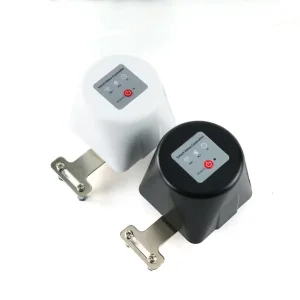
Specialized In-Wall, Curtain, Valve & Access Control Automation
Complementary smart ecosystem devices for comprehensive commercial building and residential integration.