
Best Self Powered Doorbell Suppliers in China

Time:2026-11-09 Author:Sophia
0%

China’s doorbell market offers many choices, but supplier claims deserve careful checking. A Self Powered Doorbell can use a kinetic button to generate the energy needed for a wireless signal. No battery changes. Less routine maintenance. Still, real performance depends on design, installation, and the receiver—not the label alone.

For this introduction, Wei Lin is a fictional composite product engineer, not a cited industry source. His illustrative observation is: “A self-powered button is useful only when its signal remains dependable at the front door.” That distinction matters. A button may feel solid in the hand, yet fail to communicate reliably through thick walls or across a long driveway. Ask suppliers for clear specifications, test methods, warranty terms, and documentation for the exact model being offered.

This guide explores Chinese suppliers through practical questions: how they generate power, how far signals travel under stated conditions, and what customization or quality checks they provide. It also considers enclosure materials, receiver options, and support after delivery. Details matter. A doorbell beside a metal gate faces a different installation than one mounted on a timber porch. Supplier descriptions can be polished; the evidence may be thinner. Compare carefully, and verify claims before choosing a product.
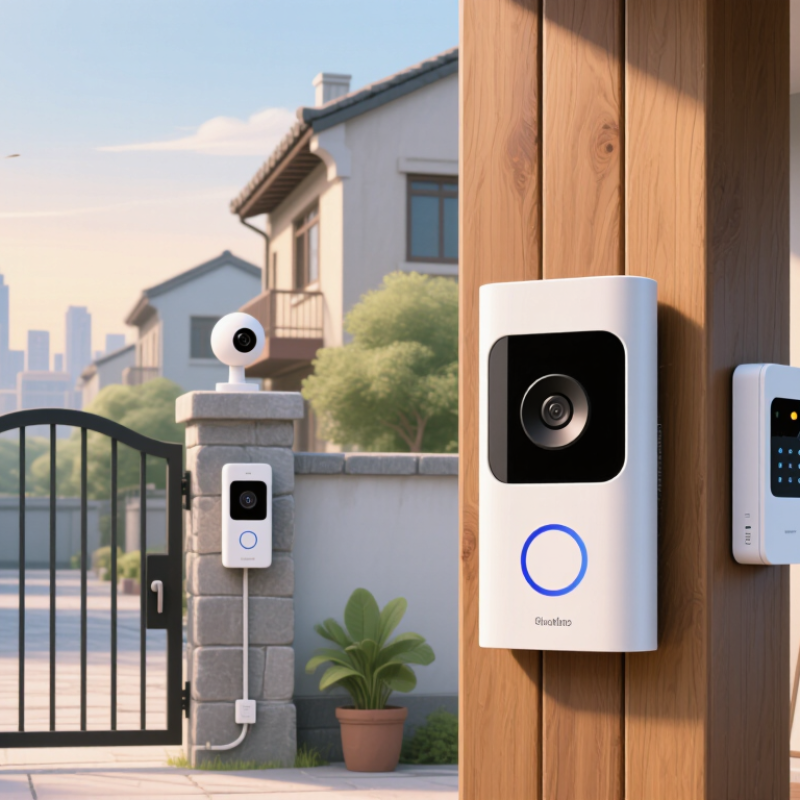
Best Self Powered Doorbell Suppliers in China

What Defines a Self-Powered Doorbell: Battery-Free Energy from a Press

A self-powered doorbell creates a brief electrical pulse when someone presses its button. Inside, a spring-driven mechanism moves a magnet past a coil, converting finger pressure into energy. That pulse can transmit a wireless signal to an indoor receiver. It does not usually power the receiver itself. No disposable battery in the outdoor button—that is the key distinction.

The press should feel firm without requiring excessive force, and the signal needs to reach the receiver through the actual walls and entryway. When evaluating suppliers in China, ask how the button performs after repeated presses and in cold or damp conditions.

Test a sample at its intended mounting height; a stated wireless range alone may not reflect a real installation. Also check whether the indoor chime needs batteries or a wall connection. “Self-powered” may refer only to the button.

The concept sounds simple, but spring travel and installation details matter. I would not assume every press generates identical energy. A weak press or poor alignment can affect performance. A practical test is worthwhile.

How Kinetic Energy Harvesting Powers Wireless Doorbell Transmitters

Best Self Powered Doorbell Suppliers in China
How Kinetic Energy Harvesting Powers Wireless Doorbell Transmitters

A self-powered wireless doorbell turns a finger press into a short electrical pulse. In common electromagnetic designs, the button moves a magnet through a coil, inducing current. That pulse powers a small transmitter, which sends a coded signal to the indoor receiver. No battery is needed in the button. The click is the power source.

The mechanism is simple, but performance depends on details. A weak press, worn spring, or poor alignment may reduce the harvested energy. Suppliers should be able to explain the generator design and provide test results for activation force, transmission reliability, and operation across realistic pressing speeds. Ask about it directly. A claimed battery-free design still needs careful verification.

MarketsandMarkets’ 2020 Energy Harvesting System Market report estimated the global market at USD 0.6 billion in 2020 and forecast USD 1.1 billion by 2025, a projected 11.1% annual growth rate. This covers multiple applications, not doorbells alone. It signals wider interest in harvested power, but does not prove any individual product’s reliability. For procurement, test samples at different temperatures and press speeds; a neat demonstration may not reflect daily use.

Best Self-Powered Doorbell Suppliers in China — How Kinetic Energy Harvesting Powers Wireless Doorbell Transmitters

Illustrative mechanical work available from a doorbell press at a fixed 2 mm button travel.

Values are calculated examples, not product or supplier measurements. Mechanical work is calculated as force × travel; the electrical energy harvested is lower because the conversion process is not perfectly efficient.

433 MHz and 2.4 GHz: Comparing Common Doorbell Communication Bands

For self-powered doorbells, the radio band affects more than advertised range. It shapes battery use, wall penetration, and receiver compatibility. In China, 433 MHz and 2.4 GHz are common options, but neither guarantees reliable reception in every home.

ITU-R Recommendation P.525-4 provides the free-space path-loss equation. At the same distance, its frequency relationship gives 433 MHz about 14.9 dB less free-space loss than 2.4 GHz. That can help a low-power signal travel through indoor obstacles. Real walls, metal doors, antenna design, and local interference still change results. The calculation is a useful reference, not a range promise. Small detail, big difference.

A 433 MHz design often suits a simple button-to-receiver link, with fewer demands on household Wi-Fi. However, its receiver and transmitter must use compatible frequencies and coding. A 2.4 GHz model may connect more readily with app-based systems, but shares spectrum with Wi-Fi and Bluetooth devices. ITU-R Recommendation P.1238-12 models indoor radio propagation across both frequency ranges, underscoring why room layout and materials matter. For suppliers, practical testing through brick, reinforced concrete, and closed doors is more meaningful than quoting open-field distance alone. The trade-off is not perfectly neat; installation conditions can overturn the expected winner.

Best Self Powered Doorbell Suppliers in China - 433 MHz and 2.4 GHz: Comparing Common Doorbell Communication Bands

This comparison focuses on product and sourcing considerations, not specific suppliers or brands. Actual performance depends on the product design, installation, local radio regulations, and building conditions.

Comparison dimension 433 MHz doorbell link 2.4 GHz doorbell link
Typical application Common for simple, low-data-rate remote buttons and wireless chimes. Used for short-range wireless devices and can support more complex connected products, depending on the radio and protocol.
Wavelength in free space About 0.69 m at 433 MHz. About 0.125 m at 2.4 GHz.
Obstacles and coverage The lower frequency often has an indoor propagation advantage over 2.4 GHz under comparable conditions. Walls, metal, antenna design, and transmit power still affect coverage. Can be more affected by walls and other obstacles than a lower-frequency link in comparable conditions. Real-world range must be tested at the intended installation site.
Potential interference Interference can come from other devices operating in or near the same regional band; the band is not interference-free. The 2.4 GHz band is shared by many devices and technologies, including Wi-Fi and Bluetooth, so local congestion may affect reliability.
Data requirements A doorbell press and chime trigger need little data; a simple low-data-rate link is often sufficient. May suit products needing a 2.4 GHz network connection or a more capable protocol, but frequency alone does not guarantee internet or smart-home functionality.
Self-powered transmitter A mechanical energy-harvesting switch, such as a piezoelectric design, can generate energy for a brief radio transmission. Confirm the transmitter’s energy-harvesting method and operating conditions. Energy harvesting is also possible, but the required energy and radio design depend on the specific implementation. Request measured performance for the offered product.
Receiver power The receiver or chime generally needs its own power source, such as mains power or batteries; “self-powered” usually refers to the button transmitter, not the whole system. The receiver or connected hub generally needs its own power source as well. Confirm whether it uses mains power, batteries, or a separate gateway.
Compatibility checks Confirm the exact operating frequency, modulation, encoding or protocol, and receiver pairing method. Products described broadly as “433 MHz” are not necessarily interoperable. Confirm the exact protocol and network requirements, as well as pairing, security, and receiver or hub compatibility. Sharing the 2.4 GHz band does not ensure interoperability.
Regional compliance Permitted frequencies, channel conditions, and power limits vary by market. Verify the target country’s requirements and the product’s applicable test reports. The 2.4 GHz band is widely used for unlicensed devices, but technical limits and approval requirements still vary by region. Check compliance for each destination market.
Supplier evaluation Ask for the exact frequency and protocol, transmitter energy-harvesting details, receiver options, test results, and samples for an on-site range test. Ask for protocol and network documentation, receiver or hub requirements, interference and range test conditions, compliance documents, and samples for compatibility testing.
Practical selection guide Consider when a simple button-to-chime link and potential lower-frequency coverage advantages are priorities; validate compatibility and local compliance. Consider when the product specifically needs a 2.4 GHz ecosystem or network capability; assess congestion, protocol compatibility, and the installed range.

Note: Frequency comparisons are general engineering guidance, not guaranteed performance claims. Ask suppliers to state test conditions and verify the complete transmitter–receiver system in the intended environment.

IEC 60529 IPX4: Assessing Weather Resistance in Doorbell Buttons

For buyers comparing self-powered doorbell suppliers in China, the button’s weather rating deserves close attention. IEC 60529 IPX4 indicates protection against water splashing from any direction under specified test conditions. It is not a promise of full waterproofing. A button beside a porch post may face wind-driven rain, wet fingers, and water running down its mounting plate. Real installation details matter.

Ask suppliers for the exact test report, including model number, test setup, duration, and sample condition. A rating for a bare enclosure may not represent a finished button with its gasket, screw holes, and energy-harvesting mechanism assembled. IPX4 does not assess dust ingress, long-term UV exposure, corrosion, or every temperature cycle. A splash test cannot reproduce years outdoors. I would check drainage and seal compression on a mounted sample, not just a datasheet. One small gap can matter.

Tips: Request installation instructions and inspect the rear seal after fitting. Test the button after repeated presses and splash exposure, then check for moisture inside. Keep the report traceable to the supplied model. Do not treat IPX4 as a substitute for careful placement; even under an eave, splash direction can surprise you.

How to Evaluate Chinese Suppliers: RF Range, Certifications, and Quality Tests

When comparing Chinese self-powered doorbell suppliers, ask for RF test results, not a single open-room range figure. Walls, metal doors, and nearby routers can cut usable distance sharply. Test the actual transmitter and receiver through two interior walls, then repeat with the receiver near common electrical devices. Record missed alerts and response time. Test it.

Check the radio frequency, output power, and intended sales markets against applicable requirements. For products using Bluetooth, the Bluetooth SIG’s 2024 Market Update projects annual device shipments will reach 5.2 billion by 2028, making coexistence testing increasingly relevant. That forecast is not a doorbell-range benchmark; suppliers should still provide product-specific interference and sensitivity results. Request copies of relevant radio and safety test reports, and verify that model numbers match the product offered. A certificate alone proves little about production consistency.

Quality checks should include repeated button presses, receiver pairing after power interruption, and operation at temperature extremes. For an energy-harvesting button, inspect whether one ordinary press reliably triggers the chime; weak presses matter. Ask for sample-size, pass-rate, and corrective-action records from recent production lots. I would not trust a showroom demo. Even these checks can miss failures after months outdoors, so include weather exposure and longer cycle testing before approving a shipment.

FAQS

What does an IPX4 rating mean for a doorbell button?

It indicates protection against splashing water from any direction under specified test conditions. It does not mean fully waterproof. Test it.

What should I request from a supplier about an IPX4 claim?

Ask for the exact test report, including model number, test setup, duration, and sample condition. Confirm it covers the assembled button.

Why inspect the button after installation?

Gaskets, screw holes, and mounting plates can create gaps. Check the rear seal and look for moisture after splashing the fitted button.

Does IPX4 cover dust, sunlight, or long-term outdoor use?

No. It does not assess dust ingress, long-term UV exposure, corrosion, or every temperature cycle. A short splash test cannot represent years outdoors.

How should I test a doorbell’s radio range?

Test the actual transmitter and receiver through two interior walls. Repeat near routers and electrical devices, recording missed alerts and response times.

What radio and safety documents should suppliers provide?

Request relevant test reports and check that their model numbers match the product offered. A certificate alone says little about production consistency.

How can I check an energy-harvesting button?

Press it repeatedly and confirm one ordinary press reliably triggers the chime. Try lighter presses too; weak presses can be easy to miss.

What quality checks help reveal production problems?

Ask for recent sample sizes, pass rates, and corrective-action records. Test pairing after power interruptions and operation at temperature extremes. I’d still want longer outdoor testing; these checks can miss later failures.

Conclusion

A Self Powered Doorbell converts the energy created by pressing its button into a small electrical signal, eliminating the need for disposable batteries in the transmitter. Inside the button, a kinetic energy harvesting mechanism captures the press and uses that energy to send a wireless signal to the indoor chime. Common communication options include 433 MHz and 2.4 GHz: each has different characteristics for range, interference, and compatibility, so the best choice depends on the installation environment and the receiver.

When evaluating Chinese suppliers, buyers should look beyond product descriptions and compare tested RF range, signal reliability, and compatibility between buttons and chimes. For outdoor use, check whether the button’s weather resistance has been assessed against IEC 60529 IPX4 requirements for protection from splashing water. Ask suppliers for relevant certification documents and details of quality checks, such as repeated press testing, transmission tests, and inspection of materials and assembly. Clear specifications and verifiable test results can help identify a dependable product for a particular project.

Sophia

Sophia

Sophia is a dedicated marketing professional with an exceptional depth of knowledge about her company's products and services. With a keen understanding of market trends and customer needs, she crafts insightful blog posts that not only inform but also engage readers, enriching the company’s online......